Thursday, October 11, 2012

Sedona's GeoHazard: The Devil's Kitchen Sinkhole


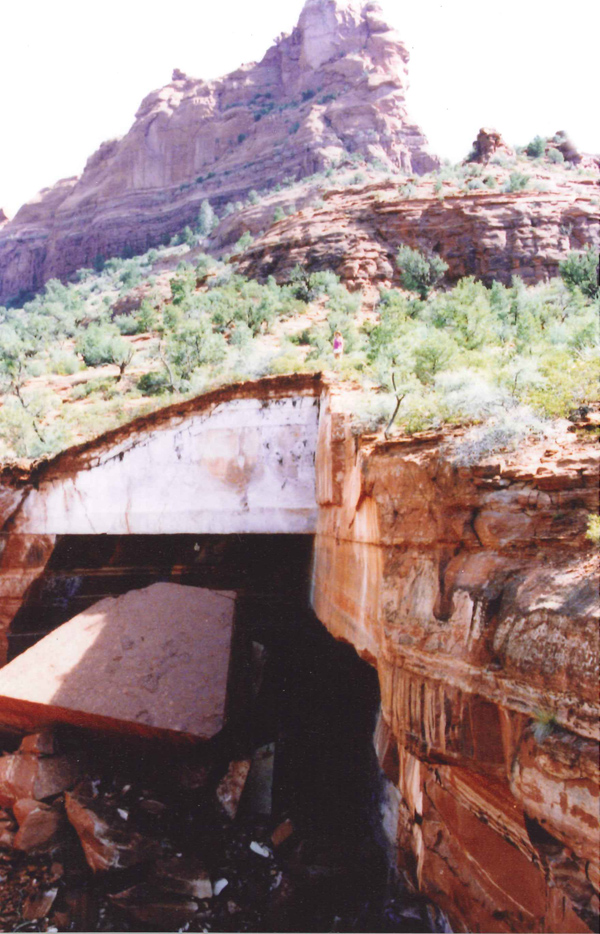
There are thought to be at least seven sinkholes in Sedona and its surrounding areas, and the most recent sinkhole was discovered in late 1989. This sinkhole, named the Devil’s Kitchen sinkhole in northern Sedona has received the most attention due to its fairly recent collapse. The initial collapse of the sinkhole is thought to have happened in the early 1980’s, yet the 1989 collapse is responsible for enlarging the sinkhole by an entire third.

Sinkholes are typically formed though a process of dissolution from the atmospheric carbon dioxide mixing with rainwater, which together make an acidic groundwater. This solution very slowly eats away at and dissolves limestone, however, no limestone is found in the immediate surroundings of the Devil’s Kitchen sinkhole. Scientists credit a deep-seated collapse of caverns in the nearby Redwall limestone as potential reasoning as to why the Devil’s Kitchen sinkhole took place.


The Devil’s Kitchen sinkhole is approximately 4510 feet above sea level and is located on a NW joint. Caves and sinkholes are often lined up along fracture zones, and once enough time has passed for the dissolution to occur on a large enough scale, it causes the cave to sink in. The stratigraphic cross sections of the rock’s strata around the Devil’s Kitchen sinkhole can be seen in the accompanying figure. 


Even though sinkholes are a natural geographic occurrence, they can still be extremely dangerous if proper cautionary steps are not taken. After thorough examination, scientists have determined the northern tip of the sinkhole to be at a greater risk of collapsing. The 1989 collapse made the northern rock wall extremely unstable in comparison to the rest of the sinkhole, and a jeep tour route for excited Sedona tourists has since been set up along the southern, considered to be safer, end of the sinkhole where there seems to be no danger of an upcoming collapse. 


Geology of Sedona, ArizonaRuins.com. 2007.http://www.arizonaruins.com/sedona/sedona_geology.html. 19 Sept. 2012.

Lindberg, Paul A. "Devil's Kitchen Sinkhole- Sedona, AZ" Arizona Geology, 2009. 
http://azgeology.azgs.az.gov/archived_issues/azgs.az.gov/arizona_geology/winter09/article_devilskitchen.html.
10 Oct. 2012.

Images taken from Goole Images and the Lindberg article.

Thursday, September 20, 2012

Formal Post #1: Rock Formations and Weathering


Sedona has been attracting millions of tourists annually for decades, and most everyone comes to look at the beautiful, towering red rocks that have made Sedona so popular. What many of these tourists don’t know, however, is that they are really looking at essentially ‘rusty rocks’ that have endured many different weathering processes.


Sedona is nestled in the Verde Valley between Southwest Mingus Mountains and the Colorado Plateau to the Northeast. These mountains were created long ago due to the earth’s plates uplifting, and the Colorado Plateau happens to be the second largest plateau in the world. It encompasses the Brice and Zion Canyons, as well as the famous Grand Canyon in Northern Arizona. The Colorado Plateau is still being uplifted 2 inches every 100 years, (Inner Journeys: Sedona Geology), creating cracks, faults and joints in the rocks which wind and water have seeped in to over time. Sedona is located on the southern edge of this plateau, exposing it to weathering and erosion, which have worked together to create the majestic red rocks of Sedona.


There is proof that Sedona has once, or multiple times, been covered with ocean water, leaving behind fossils and sediments that can still be found in the rocks today. These shells, rocks, and other miscellaneous objects could also have been brought and deposited by nearby rivers, which have rich iron flowing through their waters. The river water would flood the area, covering the rocks, and, when iron mixes with oxygen, it turns red, forever staining the rocks and giving them an overall “rusty” appearance.


The rocks not only astound people due to their vibrant color, but because of their steepness and magnitude as well. This steepness has been maintained due to the material make-up of the rocks themselves. The top layers of the strata are composed of basalt and limestone, and both of these materials are harder than the sandstone, which lies underneath. It is this water run-off eating away at the lower layers of the rock formations that aided in forming the sheer cliffs that Sedona is known for as well. 

Inner Journeys, Sedona Geology. 2010. http://www.innerjourneys.us/sedona_information/sedona_arizona_geology.php. 19 Sept. 2012.

Geology of Sedona, ArizonaRuins.com. 2007. http://www.arizonaruins.com/sedona/sedona_geology.html. 19 Sept. 2012

Friday, August 31, 2012

Intro Post

                           Sedona, Arizona


My name is Alex Pick, and I just moved to Colorado a month ago as a transfer student to the University of Colorado Denver. Although I am loving the excitement of exploring a new state completely different from Arizona, my love for my home state and its unique beauty will never go away.


My family has made regular trips up to beautiful Sedona, and they are often to hike a famous trail along Sedona's Oak Creek Canyon. A beautiful, crystal clear river runs through the bottom of the canyon, and one must follow the river to reach the destination of the hike- the ruins of a small town that once stood right along the banks of the river. In this deserted town are clues to a past civilization- one is able to walk through an old teepee made using part of a concave rock, through an old home with only the stone fireplace and window casings still intact, and through a majestic garden that is believed to have once housed magic herbs.

Sedona has made quite a reputation for itself with its colorful scenery and winding rivers, yet Sedona is also home to many popular myths and beliefs about its hidden healing powers. Sedona is said to be the home of four vortexes which are believed to be psychic places of power. It is often referred to as the "heart chakra of the planet" or the "new age capital of the world", and is able to attract over 4 million annual visitors due to this reason alone.

My love for Sedona is one that will last a lifetime, and I am extremely eager to further explore and dig in to what exactly makes Sedona so unique- everything from how the rocks get their varying shades of color to what exactly is happening among those rocks for them so emit such strong feelings of power and holiness!